Walking with Nanak by Haroon Khalid
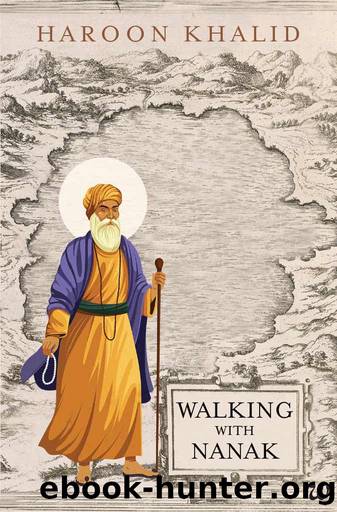
Author:Haroon Khalid
Language: eng
Format: mobi, epub
Publisher: Westland
Published: 2016-11-19T05:00:00+00:00
We walked through an empty bazaar. What was once the centre of the city was now an abandoned outpost. The hub of the city had moved to the new part of the city that was constructed after the arrival of the British. The city of Kanganpur is expanding and I cannot help but wonder if Guru Nanakâs prophecy is coming true.
Kanganpur is an ancient town that traces its origin back to Princess Kangna, the Hindu princess of Chunian at the time of the arrival of Muhammad Bin Qasim in the eight century CE. She is believed to have been martyred along with her brother, Maha Chawar whose shrine we visited in the last chapter, by members of her own family, after they both converted to Islam. There is a small fort on the outskirts of the city, now out of reach, because it has been taken over by the army. This fort is known as the fort of Kangana.
Iqbal Qaiser stopped in front of an old shop. There were remains of paintings on the back wall. The text underneath them confirmed that they were of Guru Nanak and Bhai Mardana. The people of Kanganpur did eventually acknowledge the âdivinityâ of Guru Nanak. Walking along the road that forms the circumference of this ancient city, we reached the shop of Abdul Ghaffar Razi, an old friend of Iqbal Qaiser. Ghaffar has written a book on the history of Kanganpur and its surroundings.
There was an ancient banyan tree in front of his shop, under which there was a small grave. This grave was protected by a boundary wall and was clearly being used as a shrine. Several loiterers sat on top of the long branches of this sacred tree. âThis must have been a Hindu temple,â I said to Iqbal Qaiser. âAs is the case with several other shrines, it must have been converted into a Muslim shrine after Partition, to accommodate the changing landscape of religiosity.â
âThatâs not true,â said Ghaffar. I wasnât sure if there was a hint of repressed religious sentiment hidden behind his statement. That was my initial reaction but he was a self-proclaimed socialist who acknowledged eventually that he had kept up certain features of Islamic religiosity to make his left-leaning messages accessible to the local people. âThis was not a Hindu temple. This is an ancient graveyard. In the early days, people used to find human skeletons buried under the tree.â I didnât want to challenge the authority of someone who had researched the history of his region but Iqbal Qaiser did not share my sentiments.
âIf there were human skeletons then I am afraid this was not a graveyard. This must have been an ancient mound,â said Iqbal Qaiser.
âReally? You think so?â
I was told later that Iqbal Qaiser helped Ghaffar with his project and therefore was regarded as an authority on the subject of history. âWhere were the different Hindu areas in the city?â asked Iqbal Qaiser.
âThe Hindus were everywhere. Even in this area.â
âSince the site of
Download
This site does not store any files on its server. We only index and link to content provided by other sites. Please contact the content providers to delete copyright contents if any and email us, we'll remove relevant links or contents immediately.
Professional Troublemaker by Luvvie Ajayi Jones(29668)
Empire of the Sikhs by Patwant Singh(23089)
Twilight of the Idols With the Antichrist and Ecce Homo by Friedrich Nietzsche(18638)
Plagued by Fire by Paul Hendrickson(17416)
The Sun and Her Flowers by Rupi Kaur(14526)
Norse Mythology by Gaiman Neil(13372)
A Journey Through Charms and Defence Against the Dark Arts (Harry Potter: A Journey Throughâ¦) by Pottermore Publishing(9276)
Fangirl by Rainbow Rowell(9259)
Adultolescence by Gabbie Hanna(8929)
Wonder by R.J. Palacio(8584)
Tools of Titans by Timothy Ferriss(8402)
Becoming Supernatural by Dr. Joe Dispenza(8223)
How to Bang a Billionaire by Alexis Hall(8160)
Wonder by R. J. Palacio(8115)
Crystal Healing for Women by Mariah K. Lyons(7933)
The Road Less Traveled by M. Scott Peck(7605)
The Lost Art of Listening by Michael P. Nichols(7507)
The Witchcraft of Salem Village by Shirley Jackson(7277)
The Institute by Stephen King(7043)
